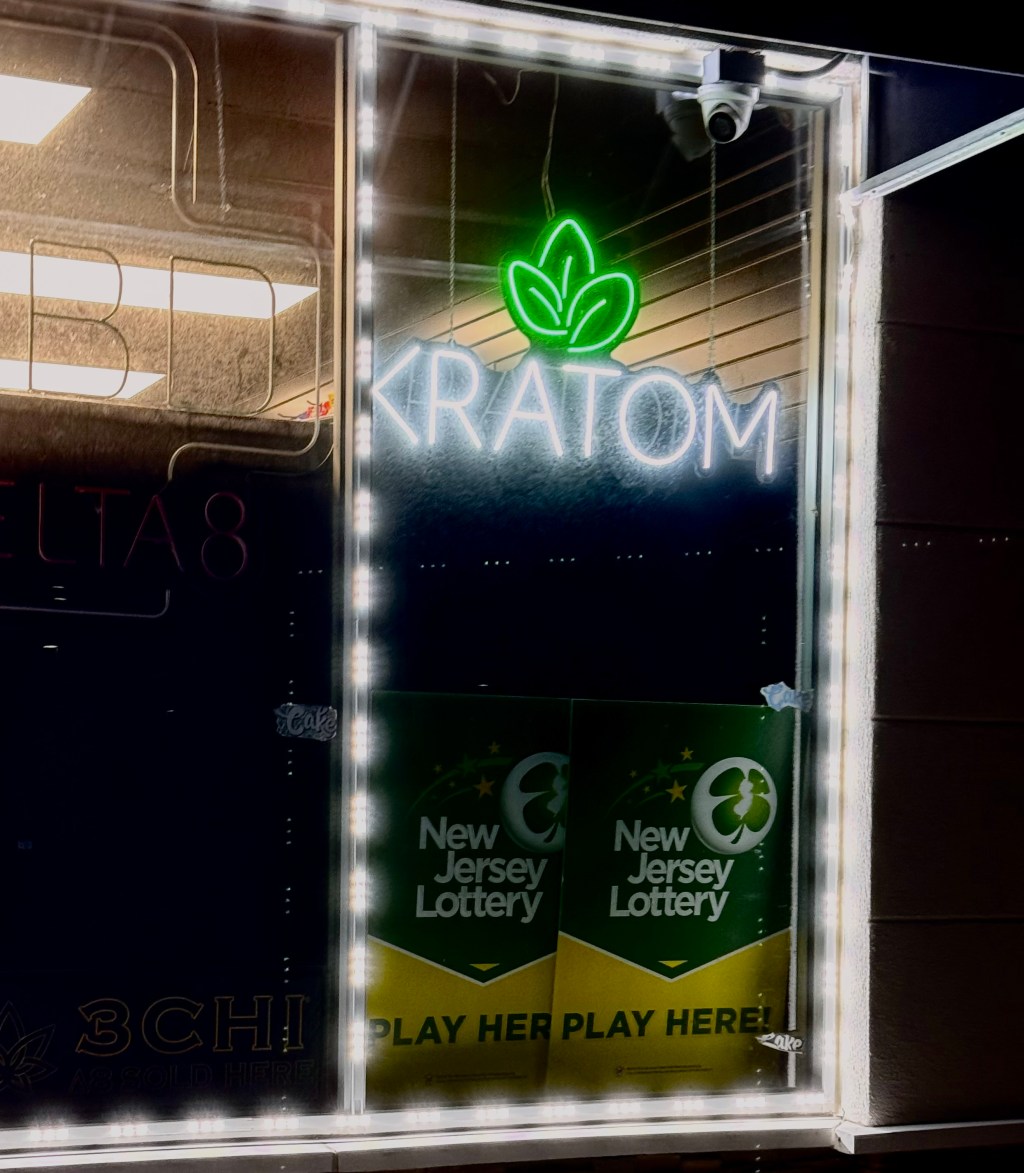
It started with ice cream.
My friend and I had wandered into one of those strip-mall ice cream spots on a summer night, the kind with a line out the door and nowhere to sit. Next door was a smoke shop. Bright white LED strips framed the windows. A green neon leaf glowed above the word KRATOM, and two New Jersey Lottery posters were taped up underneath like it was any other corner store.
We were bored, a little curious, and holding cones. So we went in.
The wall behind the register looked like a candy aisle designed by a graphic design student on a deadline. Rows of blister packs in bubblegum pink, lime green, electric purple. Brand names like Opia, Zourz, Ghost, Dopium. Little white bottles lined up by the dozen, each with a number on the label: 1250 mg, 2000 mg. Cartoon fruit. Sparkles. The whole thing had the visual language of gummy vitamins.
We asked the woman behind the counter what the pills were.
She did not hesitate. “Every person that tries this has to go to rehab.”
Then she described the effect, and she reached for the comparison everyone my age understands without explanation. It feels like Oxy, she said.
What we were looking at
Kratom is a plant from Southeast Asia. People have chewed its leaves for generations, and in the United States it has been sold for years as a powder, a tea, or a capsule, usually marketed as an energy boost or a natural way to manage pain. It is legal in most states, including New Jersey.
That is not what was on that wall.
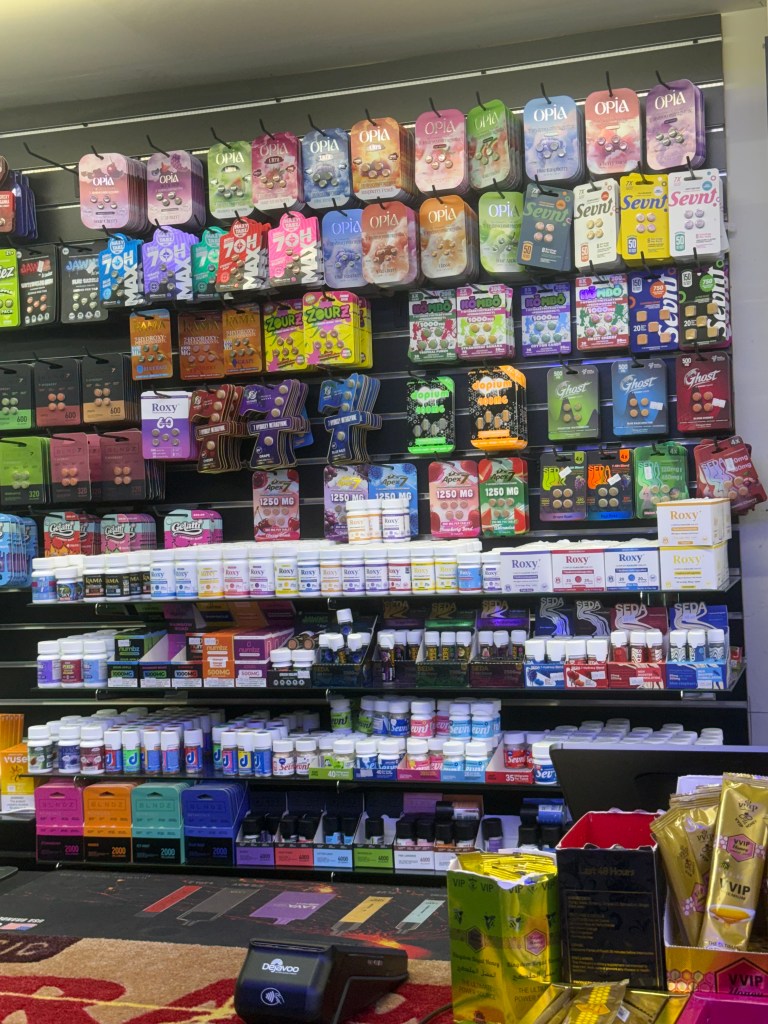
What we were looking at was 7-OH, short for 7-hydroxymitragynine. It is a single compound found in tiny amounts in the kratom leaf, isolated and concentrated in a lab until it becomes something else entirely. The FDA has called it an emerging opioid threat. It binds to the same receptors as heroin and oxycodone. It is sold in tablets that dissolve under your tongue, in flavors like blue razz and cherry, at a price point that sits comfortably next to a pack of gum.
And until very recently, it has been perfectly legal to sell it to anyone who walks in.
The timeline that should bother you
The tablets showed up in New Jersey smoke shops within the last year or so. That does not sound like a long time. It is more than enough.
Anyone who lived through the last twenty years in this country knows the pattern by heart, because it played out in our high schools and our extended families and our obituaries. Dependency. Addiction. Rehab. Relapse. Rehab. Somewhere in that cycle, a funeral. The only thing that changed between the OxyContin years and now is the packaging. The pills used to come from a pharmacy. Now they come with a lottery poster in the window.
Other states moved faster. Florida passed an emergency ban on 7-OH last summer. Vermont banned kratom and everything derived from it. As of this summer, at least nine states prohibit 7-OH outright, and more have set limits on how concentrated a product can be.
New Jersey is getting there, slowly. Senator Shirley Turner introduced a bill (S301) that would add 7-OH to Schedule I of the state’s Controlled Dangerous Substances Act, the same category as heroin. It cleared the Senate health committee unanimously in March. Then it was sent to the Budget and Appropriations Committee, and as of late August, that is where it still sits. No floor vote. No signature. Five months of a shelf being restocked.
At the federal level, the DEA filed notice on July 1 of its intent to temporarily place 7-OH on Schedule I nationwide. That is the strongest signal yet that Washington sees what that woman behind the counter already knows.
The part that keeps me up
Here is what I cannot shake. The manufacturers are already ahead of the law.
At a smoke shop trade show in Atlantic City this spring, vendors reportedly showed up with pallets of 7-OH to clear out before the bans hit, and with new products in hand for the day after. Different plant, similar alkaloids, not named in any bill. When 7-OH is finally illegal, something with a fresh name and a sleeker box will be on that same wall within weeks, and the whole cycle starts over. Legislators will hold hearings. Someone’s kid will testify. A bill will crawl through committee. Meanwhile the shelf is restocked.
We regulate by chemical name. They innovate by chemical name. That is a race the public is going to lose every single time unless the rules change shape.
What I keep coming back to
I do not have a policy prescription, and I am suspicious of anyone who says this is simple. Some people genuinely use kratom to get off harder drugs, and a Schedule I label carries its own damage. That debate is real and worth having.
But I know what I saw. A wall of opioid-adjacent pills in candy packaging, sold by someone who told two strangers, unprompted, that everyone who tries it ends up in rehab. Next to an ice cream shop. On a Tuesday.
The first opioid epidemic hid behind prescriptions and professional authority. This one is hiding behind a neon leaf and a lottery poster, and it is counting on the rest of us to keep walking past.
I almost did.
 Jenna Kronyak
Leave a comment