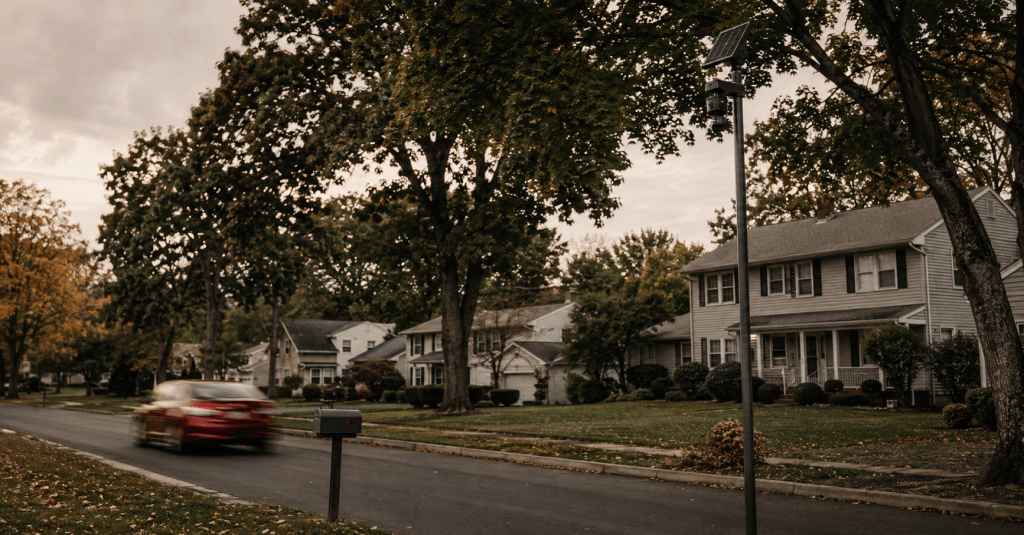
There is a pole on the road into my town that I did not notice for months. It is about twelve feet tall, has a small black box on top angled at the rear bumpers of passing cars, and it runs on a solar panel the size of a cookie sheet. It does not look like anything. That is the point. It is a Flock camera, and it has been photographing my license plate every time I go to get coffee.
I am not a conspiracy person. I work in real estate communications. I spend my days making warehouses sound interesting. But somewhere between the first Flock camera I noticed and the fifth, I started paying attention, and what I found is a very strange little story about how a startup quietly built one of the largest surveillance networks in the country, one town council at a time.
What it actually does
A Flock camera is not a traffic camera. It does not care whether you ran a red light. It photographs every car that passes, reads the plate, logs the make, model, color, and any distinguishing details (a roof rack, a bumper sticker, a dent), and stamps the whole thing with a time and location. Then it uploads that record to Flock’s cloud, where it sits in a searchable database that participating police departments can query.
Multiply that by roughly 120,000 cameras and more than 5,000 law enforcement agencies nationwide, and you get something that no single police department could have built on its own: a rough map of where nearly everyone’s car has been. Not just the stolen ones. Everyone’s.
Here in New Jersey, an NJ.com investigation put the count at more than 500 Flock-style cameras statewide. Volunteer mappers at DeFlock, who crowdsource camera locations, have logged far more than that. They are in Westfield, Franklin Township, Secaucus, Atlantic City, Fort Lee, and, if their map is right, most of the towns between here and wherever you are going.
Nobody voted on this
This is the part that gets under my skin. Flock did not arrive through a statewide policy debate. It arrived through a sales rep giving a slideshow at a Tuesday night council meeting that eleven people attended. A grant covers the first year. The cameras go up. A year later they are just part of the landscape, and the question of whether we wanted a permanent record of our comings and goings never really got asked, because it was never framed as that question. It was framed as “would you like to catch more car thieves.” And yes, obviously, who says no to that.
The data sharing is the quiet multiplier. Your town’s cameras can be searched by agencies far outside your town, under whatever agreement your police department signed. For a long time the default retention was 30 days, which sounds short until you realize 30 days of location data is enough to establish where you live, where you work, where your kids go to school, and who you visit on Saturdays.
The backlash finally showed up
This summer, something shifted. Flock cameras have been vandalized in at least 36 states. Sawed down, painted over, stolen, shot at. A man in Massachusetts stands in front of his local camera with a roof rake and a sign for half an hour at a time. In Westfield, News 12 was out filming the damage last week. Franklin Township residents organized against their program. A statewide petition is circulating, and there is a bill in Trenton.
Flock responded on August 13 with reforms: every search must now be tagged to a criminal case number, unusual search activity triggers an automatic review and lockout, the default retention drops to seven days, and towns can limit what offenses other agencies can search their cameras for.
Those are real improvements. They are also, as one privacy lawyer put it, the same “just trust us” policy with a fresh coat of paint. The company is still asking thousands of police departments to police themselves. And to be clear, I am not endorsing the guys with the hacksaws. Destroying public property is not a policy position. It is, however, a signal that a lot of people feel they were never given a legitimate way to say no.
The honest part
The cameras work. That is what makes this hard to write. Denver police credited theirs with 275 arrests and 180 recovered vehicles, including a lead in a $12 million jewelry heist. Amber Alerts get resolved faster. Stolen cars get found. When Denver’s council voted unanimously in August not to renew the contract anyway, it was not because the cameras failed. It was because the council decided the trade was not worth it.
I keep coming back to that. This is not a story about technology that does not work. It is a story about technology that works so well, and so invisibly, that we skipped the conversation about whether we wanted it.
What I am actually asking for
Not a ban. I am asking for the conversation we did not have. Publish where the cameras are. Publish the retention period and the data sharing agreements in plain English on the township website, not buried in a PDF from a 2023 council packet. Require a vote, with public notice, before a contract renews. Let residents file a records request and actually get an answer.
If you want to know whether your town has them, DeFlock has a map. If you want to know what your town’s policy is, OPRA is your friend. And if you want to do something about it, the boring answer is the right one: go to the council meeting. Bring friends. It is astonishing what eleven people who bothered to show up can get through, and that cuts both ways.
The camera at the end of my street is still there. I would just like to know who decided that, and I would like it to have been us.


Leave a Reply