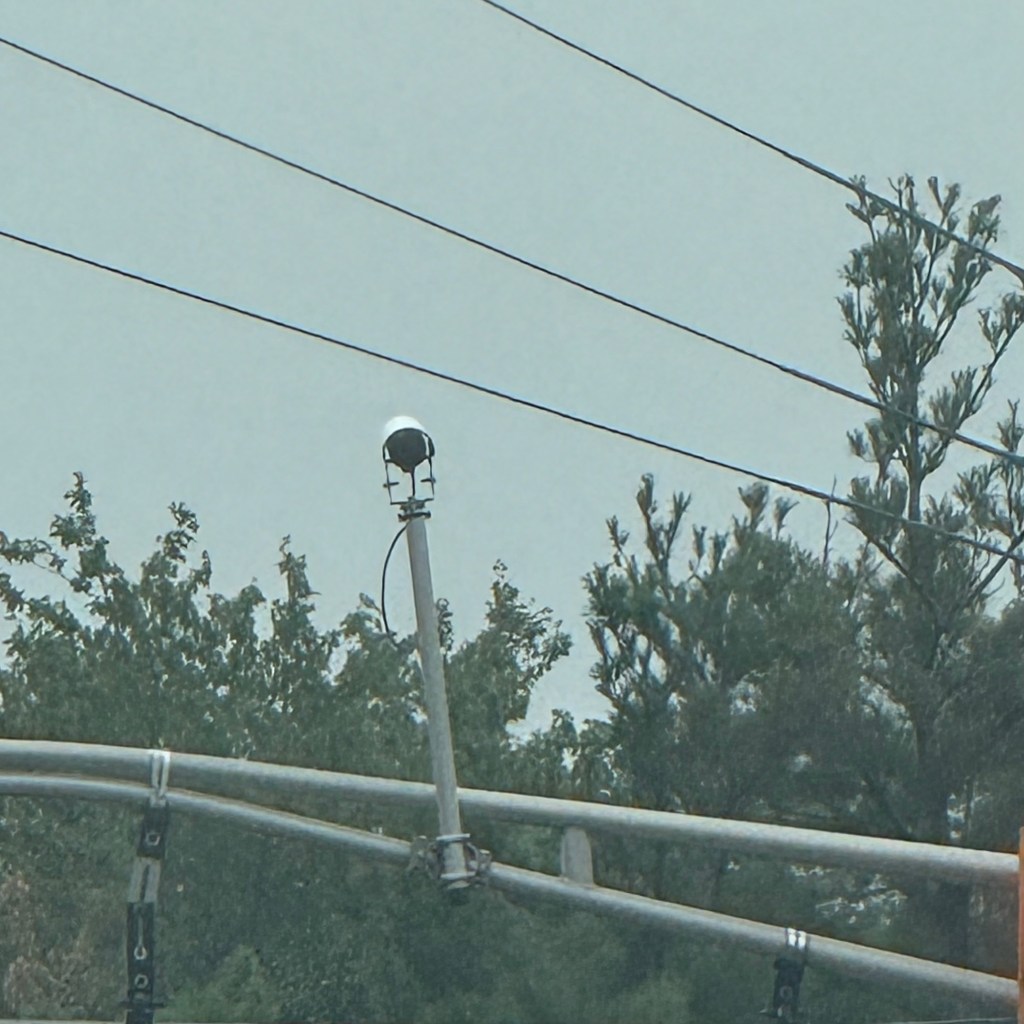
On my normal drive to work this morning, somewhere in the middle of Sayreville, I started counting cameras and had to stop because it was ruining my commute. They were everywhere once I let myself see them: Flock-style plate readers on their skinny solar-powered poles at the corners, dome cameras riding the traffic signal mast arms, little boxes I could not identify tucked above the crosswalk signs. Every turn I made, through every intersection on a route I have driven thousands of times without noticing anything, something was mounted on a pole watching it happen. By the time I got to the office I was genuinely unsettled, not because any one camera alarmed me but because of the density, the sense that the whole drive had been quietly instrumented while I was busy looking at the road.
New Jersey drivers of a certain age have a specific reflex to intersection cameras, because for five strange years this state mailed people tickets based on what a camera saw, and the assumption is always that the ticket machine is back. It is not. Whatever those cameras in Sayreville are doing, they are almost certainly not writing anyone a summons, because automated ticketing has been dead in New Jersey for more than a decade. What most of them are doing instead is quieter, and to my mind more interesting: they are taking attendance.
The five years we mailed tickets
The history is worth getting right, because it is usually remembered wrong. New Jersey never passed a law banning red light cameras, and the state never declared them a violation of anyone’s privacy. What happened is that in 2008 the Legislature authorized a five-year pilot program, and starting in December 2009 about two dozen towns installed cameras at 73 intersections that photographed cars running reds and mailed the owners $85 tickets.
The program was a mess almost immediately. In 2012 the state suspended most of the cameras because the yellow lights had been timed by a different formula than the one the law required, which meant thousands of people may have been ticketed at intersections where the yellow was simply too short. Critics, led by a state senator who made this his signature fight, argued the cameras were less about safety than about revenue, and the towns’ own enthusiasm for the money did not help the counterargument. When the pilot hit its expiration date in December 2014, the Legislature just let it die. The cameras came down, the towns got 90 days to mail their final tickets, and that was the end of automated enforcement in New Jersey. The state later went further and moved to block other states’ camera programs from reaching New Jersey drivers at all, so that a red light camera in New York City would photograph a Jersey plate and have nobody to send the bill to.
So the folk memory is half right. The ticket camera is gone and the political appetite to bring it back is roughly zero. But notice what actually got killed: the fine. The photograph was never the problem anyone solved.
What is on the pole now
Which brings us to the boxes going up today, because cameras are absolutely going up at New Jersey intersections right now, and they fall into two families that look similar from a car window and could not be more different in what they do.
The first family is traffic management. NJDOT and the Turnpike Authority run hundreds of cameras on highways and major arterials, the dome-shaped ones usually mounted right on the signal mast, and they exist to watch congestion and crashes. You can view many of them yourself on the 511NJ site, they are explicitly not used for enforcement, and most do not record much of anything. They are watching traffic, not you.
The second family is the one I wrote about last week when I found a Flock camera at the end of my own street. Automated license plate readers are small boxes on their own skinny poles, usually solar-powered, angled at rear bumpers, and they photograph every car that passes, log the plate, the make, the model, the color, the dents and the bumper stickers, and stamp it all with a time and a place. Community mappers have documented somewhere around 1,680 of them across New Jersey, in Newark and Jersey City and Trenton and a long list of towns nobody writes about, and busy intersections are among their favorite spots, precisely because an intersection is where everyone eventually shows up. Some belong to police departments. Some belong to shopping centers. In at least one Ocean County neighborhood, plate readers appeared at the entrances to a residential development and reporters could not immediately determine who owned them.
Why now
The short answer is car theft. When thefts surged after 2021, the state put $10 million into automated plate readers, the Port Authority spent another $10 million wiring the bridges between New Jersey and New York with them, and grant money started flowing to local departments, which is exactly the sales environment in which a company like Flock thrives, one town council presentation at a time. The pitch works because the technology works; the bridge cameras get credit for a real drop in thefts, and nobody wants to be the mayor who voted against finding stolen cars. I covered how that adoption pattern goes in the Flock piece, so I will just say the intersection version is the same movie with better locations.
The longer answer is that the 2014 fight settled the wrong question, or at least a narrower question than everyone remembers. That fight was about money: short yellows, $85 fines, towns treating a safety program like a toll booth. Nobody needed to litigate whether the state could photograph your car at an intersection, because the objectionable part was the envelope in the mail. So the envelope was banned and the photographing was not, and a decade later New Jersey is the state that killed the camera that costs you $85 and is busily installing the one that remembers where you were.
The trade nobody named
I keep turning that over. A red light camera photographed you only when you broke the law, at one intersection, and the encounter ended with a fine you could fight in court. A plate reader photographs you every time, everywhere one is mounted, and the encounter ends with a database entry you will never see, searchable by people you will never meet. One of those produced a decade of outrage, legislative hearings, and a permanent political taboo. The other produces a shrug, because nothing arrives in the mail.
I am not arguing for the ticket camera’s return, and after the yellow-light business, New Jersey was right to be furious. I would just point out that we turned out to be a state with a very precise sense of what surveillance we will not tolerate: the kind that bills us. The kind that merely watches, we are installing at the intersection as fast as the brackets can be mounted. The next time you are stopped at a light, look up at the mast, then look at the skinny pole on the corner, and know that only one of them is nothing to worry about.
 Jenna Kronyak
Leave a comment